
Sustainability is the “new normal” in investment. This poses a challenge to providers who have so far been able to differentiate themselves through sustainable investment strategies to maintain their competitive edge. At the same time, providers without a particular sustainability profile are considering how they can catch up with the competition.
Our client pursues the goal of placing sustainability as the core of its consulting proposition. He asked us to anchor this goal in the consulting process in such a way that consultants are supported in addressing the topic with customers and that they experience sustainability directly and individually.
As a result, the strategic goal of sustainability was made tangible for employees and customers – contributing to significant growth in sustainably invested assets.
Transaction-oriented pricing models have the disadvantage that they often do not adequately remunerate advisory services that have already been provided. This problem has been exacerbated by rising litigation costs in securities consulting, partly due to regulatory requirements. In addition, there are other challenges, such as dealing with conflicts of interest. As such, flat-rate pricing models (“all-in fees”) have gained considerable importance.
The challenge in introducing these models is to clearly define and differentiate the defined service models. To do this, the services must also be attractive to customers who only trade on a small scale.
Our customer approached us with the request to analyze the existing portfolio of offers and to support him in defining a new offer.
As a result, together we managed to
Overall, we succeeded in reducing volatility in the area of WP commission income, increasing the average margin and acquiring new assets from existing customers and from the market via modernized service models.
For almost all wealth managers, the quality of advice – and thus the quality of the client advisors – is one of the key unique selling points. Against this background, it is not surprising that excellent client advisors are in high demand on the market. Consequently, personnel expenses represent the key cost factor in a WM business model.
Our client pursued the goal of increasing the client/advisor ratio without reducing the quality of service. As Consileon, we were able to combine our extensive expertise in the high net worth client business with our knowledge of advisory software to implement a hybrid advisory process.
As such, the customer’s strategic objectives were fully achieved.
Even in IT development or software development, the customer should be king. But who exactly is the customer? The board of directors or division manager who approved the project? That’s how it used to be seen. Today, the focus is on the end user. Another, often still neglected target group are the administrators who operate and maintain the system in productive use.
With the shift in customer focus, the understanding of leadership must also change. For agile software development to work, higher hierarchical levels should respect the product owner, quite literally as the owner or entrepreneur of the agile project. In addition, the self-image of the teams is important. After years of socialization in the company hierarchy, it is difficult for developers to switch from simply working through the specifications to taking responsibility themselves.
Only when these two cultural hurdles have been overcome, or it can be assumed that this will be successful in the upcoming project, is it advisable to switch from classic requirements management to new techniques such as design thinking or the customer journey.
The complex product development of car companies is reflected in strictly hierarchical management. If you ask product owners working at the manufacturer how a board meeting affects their project work, it turns out that preparing for the meeting takes up to three quarters of their working time. This blatant shift in priorities shows how costly the assignment to the hierarchy can be compared to personal responsibility.
A rigid hierarchy also clashes with the increasingly dynamic demands placed on products and projects. Extensive feedback loops across all management levels take too long in the digital age to achieve competitive advantages. Continuous dialog with users and administrators delivers faster results.
Customer-oriented approaches such as design thinking or value stream mapping (VSM), which is common in the Japanese automotive industry, are suitable as an introduction to agile development. Another source of knowledge is “shadowing,” in which the developer looks over the user’s shoulder. Such methods deepen the employees’ understanding of the customer and pay off in the form of tailored products.
For almost two decades, companies in the automotive industry have valued Consileon as a strong partner. However, the changeover to agile working can do more harm than good. In addition to the costs of the failed change, there is the mortgage of the loss of trust among staff. Even if managers or specialists would rather work according to the latest agile model yesterday than today: Those who start with a down-to-earth method and are patient with the next step until agile thinking has arrived in the minds of their colleagues achieve more on the bottom line. “Bridging techniques” such as design thinking, customer journey, or value stream design are good places to start. We are also familiar with these techniques. Talk to us!
Retail in the automotive industry is traditionally characterized by large sales areas with face-to-face sales in car dealerships. Due to the capital intensity of this business model, this is where digitization comes in. Since customers must continue to be at the center of business, it is important to satisfy their wishes well and sustainably.
Digitalization is currently leading to a profound change in the prerequisites and rules of the game in automotive retail. The decoupling of goods storage and presentation is increasing noticeably. Cost-intensive inventories in particular are being replaced by computer-animated presentations. Currently, the incentive to present a product virtually increases linearly with the cost structure. In addition, the range of products per product line is increasingly varying in some areas. Examples of this are the product variety at Coca-Cola or the VW Golf. In addition to the “original Coca-Cola,” there are currently nine other variants. The increasing complexity of products makes it more difficult to excite potential customers; while the average customer’s attention span is decreasing due to the daily flood of data and information. Under certain circumstances, this can make it difficult for a customer to make a purchase decision.
Automobile manufacturers have long since recognized that vehicle sales must also take place online. There are various innovative approaches for this. High-resolution VR views and 360-degree views allow customers to experience the desired car realistically even before they order it. They can easily change the configuration in the visualization and thus play through different variants. This puts buyers in a position to compare variations of the product and optimally tailor their purchase decision to their needs. Daimler AG in South Africa, for example, is planning to completely digitize the sales process. Only the test drive and vehicle handover will still be carried out on site at the dealership.
Thanks to numerous projects in the digital environment of the automotive sector, we have extensive know-how in this area. This wealth of experience enables us to build digital interaction channels in a targeted manner. We develop custom-fit strategies for your vision. Together, we then implement these concepts technically and professionally. In addition, we support your operational and international rollout if required. When defining suitable key performance indicators and success factors, we contribute our in-depth knowledge and experience. In this way, we enable you to set your goals realistically and meaningfully.
During this course, participants will gain the knowledge required to lead a lean, agile enterprise using the Scaled Agile Framework® (SAFe®) and its underlying principles derived from lean, systems thinking, agile development, product development flow, and DevOps.
Participants in the course will gain insights into mastering business agility to succeed in a competitive environment. It will discuss how team and technical agility can be established and how a company can organize and reorganize around the value stream.
Furthermore, they will learn the skills to support and execute PI planning events and coordinate multiple Agile Release Trains (ARTs). They will also develop an understanding of how to implement a Lean Portfolio Management function in their organization.
Attending the course prepares you to take the Certified SAFe Agilist (SA) exam.
The training can be delivered as a two-day face-to-face event or a three-day online training by arrangement.
The Corona crisis affects life and everyday work in Germany. An exceptional situation and challenge for every employee and employer:
What does all this mean for managers in the automotive industry? What is important when leadership is only possible by means of digital media?
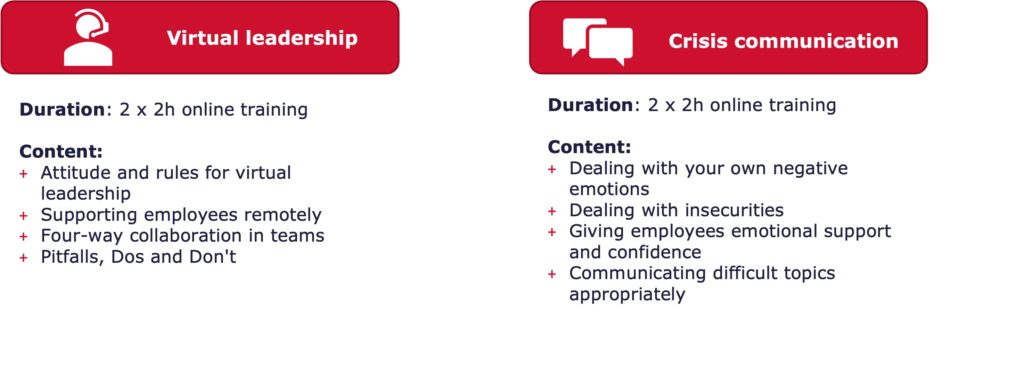
Our training program prepares you as a manager for the new challenges and shows you what is important in virtual leadership.
We offer two training courses with the content below:
The Corona crisis is having an impact on life and everyday working life in Germany. It’s an exceptional situation and a challenge for all sales staff at the dealership.
Is it the same for you?
Our offer
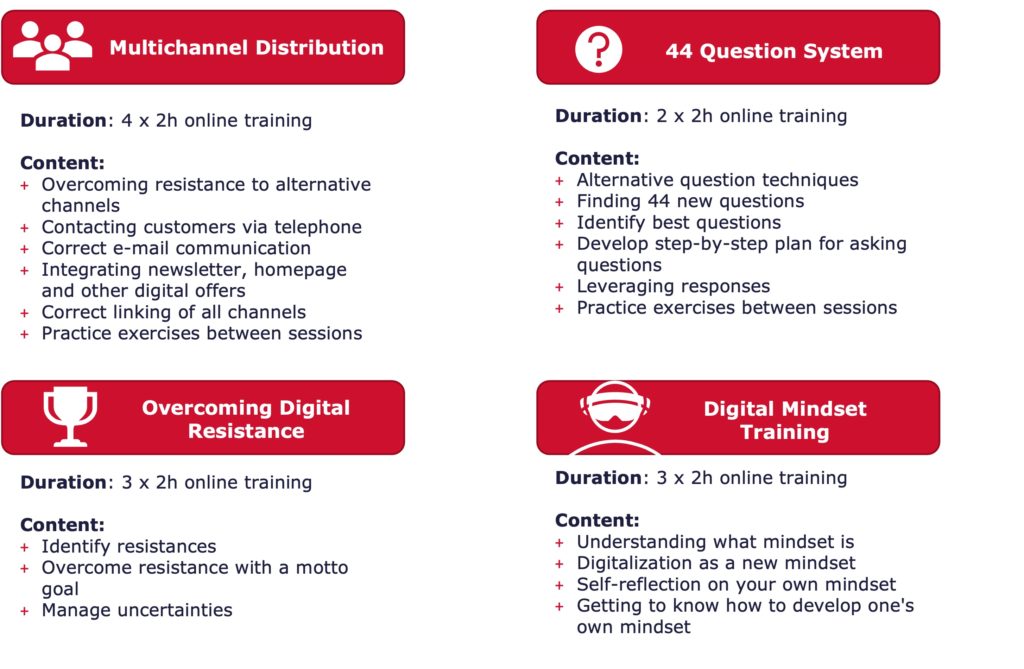
We offer you a modular training program for your sales force to be able to sell cars in the best possible way under the prevailing circumstances.
With the help of four different trainings from which you can choose, we can coach your employees to make the best out of this crisis situation.
The current trend towards agilization is an immense challenge, especially for larger companies. Since the classic approaches Scrum and Kanban can often only be applied to a few players, scaling makes sense.
In recent years, various frameworks for scaling agile working methods have been developed and published as a solution for this. Since each model is based on its own approach and interaction between team members, not every framework is suitable for every company. In this article, you will find a presentation of each approach, including the respective advantages and disadvantages in application.
Rarely in history has anything affected companies as much as the current Corona crisis. In order to slow down the further spread of the virus, many employers were forced to send their employees to the home office at short notice. This gave IT departments very little time to prepare for the new situation – especially in companies where telecommuting was previously uncommon.
But now the Corona epidemic has become a reality, and there are signs that this state of affairs could continue for some time. At the same time, figures from around the world show that attacks on computers and networks are increasing by leaps and bounds as the pandemic progresses.
The most important factor for security in the network is and remains the person himself. We would like to provide employees and employers with a few quick wins that can make daily work in the home office significantly safer. Many of these also apply to normal everyday (work) life. But with the crisis, new cybercriminal schemes have emerged that need to be recognized and countermeasures taken.