
In Germany, around 130,560 plug-in hybrids and 34,357 pure electric vehicles were sold in 2018. With up to 3.4 million registrations annually in total, these two market segments together account for a market share of just under five percent. In the previous year, only 25,056 pure electric cars were registered. This indicates a positive trend.
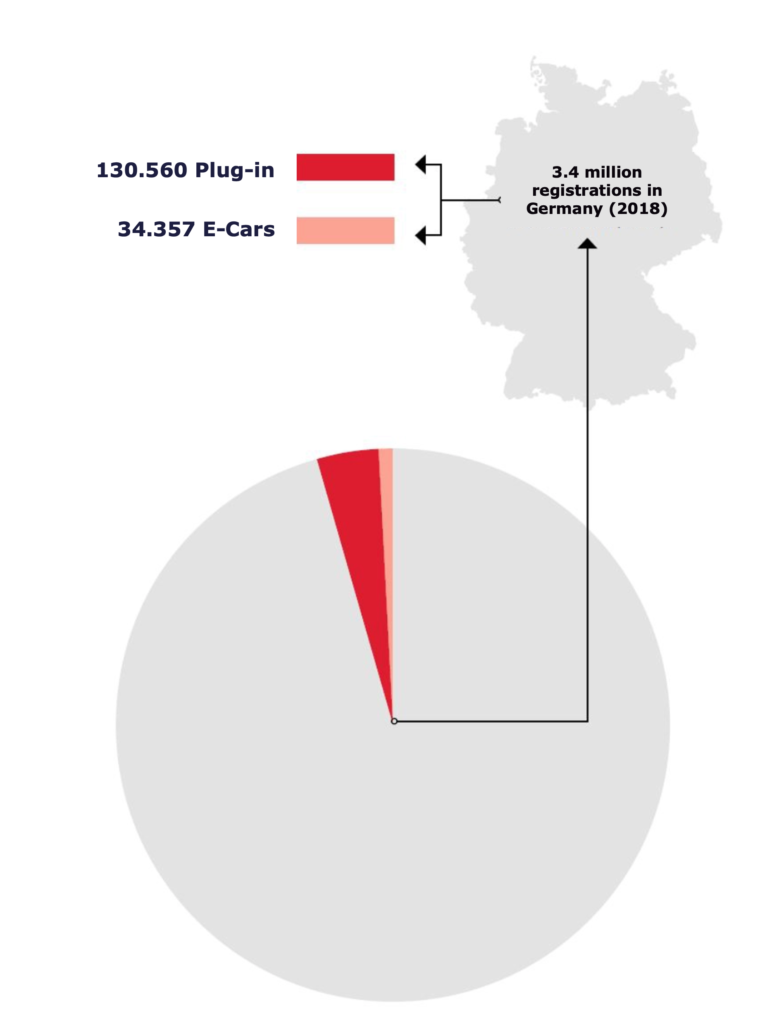
The moderate market share contrasts with the expectations of the target group. According to a panel study by the British opinion research institute YouGov, 55% of drivers see the e-car as the means of transport of the future. Nevertheless, in addition to the purchase price and range, respondents cited the distance to the nearest charging station as a key hurdle before making a purchase.
A project designed to make everyday life easier for e-mobilists comes from Apple. The American tech company has started to include the charging stations of the operator Chargepoint in its digital street maps. However, this function is not yet available in Germany.
The European Alternative Fuels Observatory (EAFO), which is funded by the European Commission, currently counts 16,055 electric charging stations in Germany with a total of 48,367 connections. For 2020, the German government’s National Platform for Electromobility (NPE) anticipates a need for 70,000 public charging points, including 7,100 fast-charging stations.
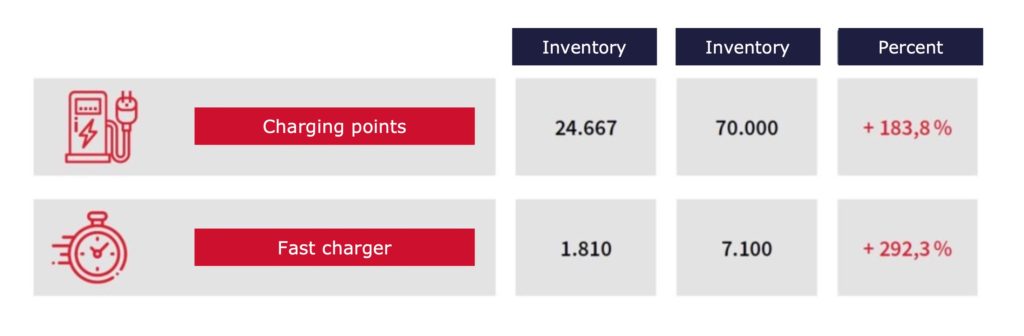
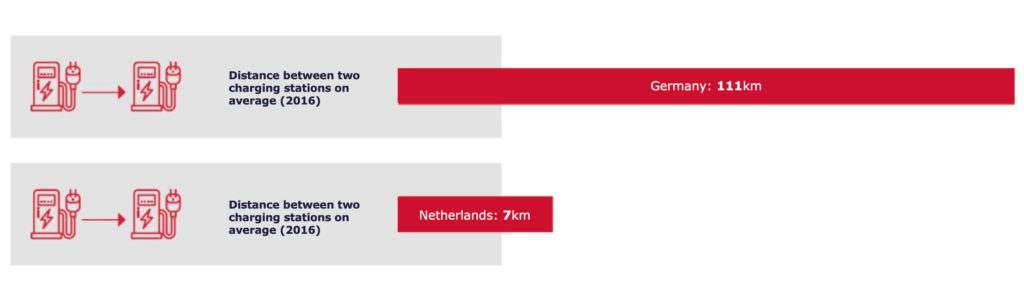
In 2018, the number of charging points in Germany increased by more than 340%. In absolute terms, Germany is the European leader with 48,367 charging points. However, if you compare this figure with the country’s surface area and population, it becomes clear that others are leading the way in terms of electromobility. While Germany’s e-mobilists found a charging station every 111 kilometers on average in 2016, in the Netherlands it was only seven kilometers away.
In order to make improvements, the German Federal Ministry of Transport and Digital Infrastructure issued the first 26 funding notices for charging columns totaling a good 550,000 euros on June 9, 2017. The program is intended to establish a nationwide charging infrastructure with 15,000 charging stations. To this end, the ministry is providing a total of 300 million euros by the end of 2020, two-thirds of which for fast chargers.
The head of the electric mobility division at Mercedes-Benz, Jürgen Schenk, however, urges calmness. Thanks to advances in battery development, there will soon be an oversupply of charging stations. Ranges of 500 kilometers and more are on the horizon. At that point, fast chargers along the highway will be sufficient.
Fast charging is currently only possible at 1,810 charging points in Germany, of which more than twenty percent are Tesla’s so-called Superchargers, which are reserved for drivers of the brand. The state and private companies are trying to drive forward the expansion of the infrastructure needed for electromobility with projects that are attracting a lot of media attention. One example is the so-called fast-charging axis along the A 9 between Munich and Leipzig. Siemens, Eon and BMW set up eight fast-charging stations there in mid-2014 at intervals of no more than ninety kilometers. Tesla is running its own major project in Europe. The carmaker supplies its customers with electricity free of charge at a good 700 charging stations with almost 5,000 connections. Daimler, BMW, Volkswagen and Ford have joined forces in a similar project. Together, they want to install several thousand fast chargers along Europe’s main traffic routes. The first 400 are planned for 2019. The German Federal Ministry of Transport wants to install another 400, also by the end of the year, although only one hundred of these had been completed by the end of July. The planning basis is provided, among other things, by the SLAM (Fast Charging Network for Axes and Metropolises) research project presented at the Hanover Fair in 2017.
Four systems for charging traction batteries dominate the European market: Schuko, Type 2, CCS and Chademo. The most popular is the alternating current from the household socket via the Schuko plug. With this, an empty battery can be fully charged in eight to twelve hours at a power of 3.6 kilowatts. A positive side effect of the long duration is that the battery is protected and lasts longer overall. In addition, the charging loss is lower. The EU standard is the Type 2 connector. It normally charges with alternating current and is compatible with its successor CCS (Combined Charging System), which also works with direct current. The Japanese competitor product Chademo works in a similar way to CCS. Across systems, a distinction is made between normal (AC) connections and fast chargers. The latter accept direct current and fill the battery to 80% in half an hour. CCS and Chademo are best suited for this purpose. But even with the older Type 2, a charge level of 80% can be achieved in under an hour with direct current. Because of its compatibility with the Type 2 plug, the German car companies rely on CCS. Chademo is mainly installed by Asian brands and is therefore widely used in Asia and America. Tesla is also taking a special approach to fast charging with direct current: In its European charging station network, the U.S. manufacturer uses a proprietary charging plug based on Type 2.
Beyond the plug-in competition, a technology is on the horizon that could displace all of these systems and erase the word gas station from our vocabulary: inductive charging. Similar to the batteries in electric toothbrushes or smartphones, traction batteries can pick up electricity without contact via coils in cars as well as in private or public parking areas or even in the roadway. In the car, the coil is mounted under the front axle; in the ground, it lies under a plate measuring just under one square meter. The distance between the two coils is ten to fourteen centimeters. BMW is already using the technology in special vehicles in Formula E races. The charging plates can be recessed into the ground and only identified by colored markings. The vehicle takes a short charge there while parked. This so-called snack charging puts less strain on the battery than continuous or full charging.
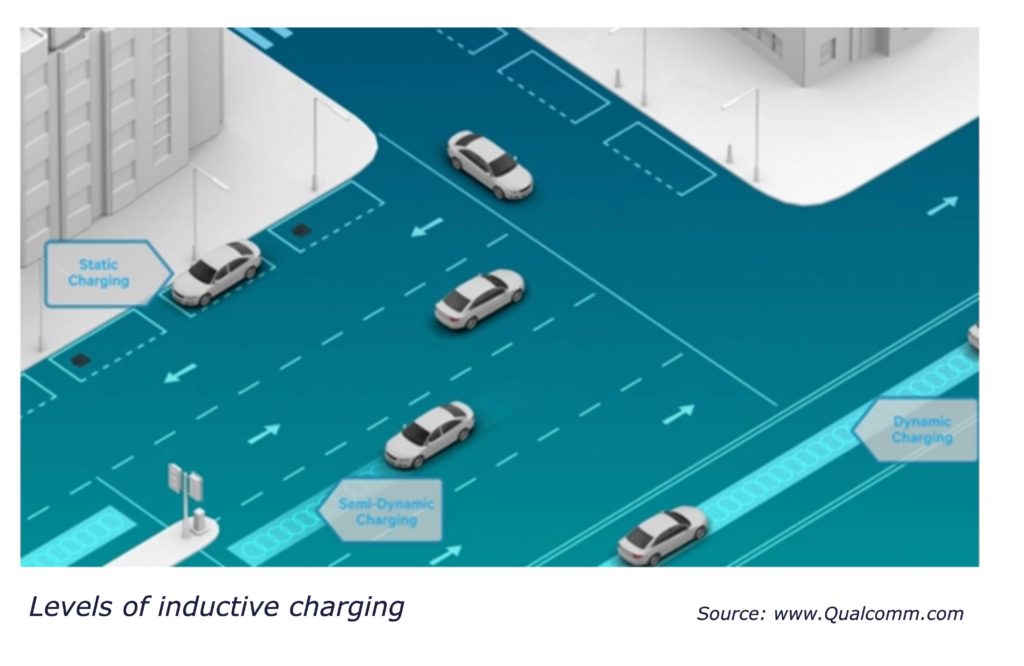
Alongside BMW and Audi, Nissan is one of the suppliers most advanced in wireless charging. The Japanese are currently testing a system in which semi-autonomous e-cars exchange information, automatically navigate to the charging point and clear it for other vehicles once the power snack has been taken.
But this is still a long way from exhausting the technology. The next step is inductive power consumption at low speeds over short distances, known as semi-dynamic charging. Examples include cab stands, traffic lights and railroad crossings. In Braunschweig and Berlin, some e-buses are already being charged with electricity at bus stops on a trial basis. The final stage of development would be dynamic charging while the vehicle is in motion. An EU project called Fabric is underway on a test route in France. The idea is to install a series of charging plates in one lane of the highway that inductively supply electricity to the traction batteries of electric cars at speeds of 120 km/h.
Setting up a Type 2 charging station with two charging points costs around 10,000 euros today, while a fast charger costs more than three times that. Thanks to rising unit sales, the price of a simple charging station is likely to drop by a quarter to 7,500 euros over the next three years. Nevertheless, it will not be possible to earn money in the medium term from the construction and operation of charging stations alone.
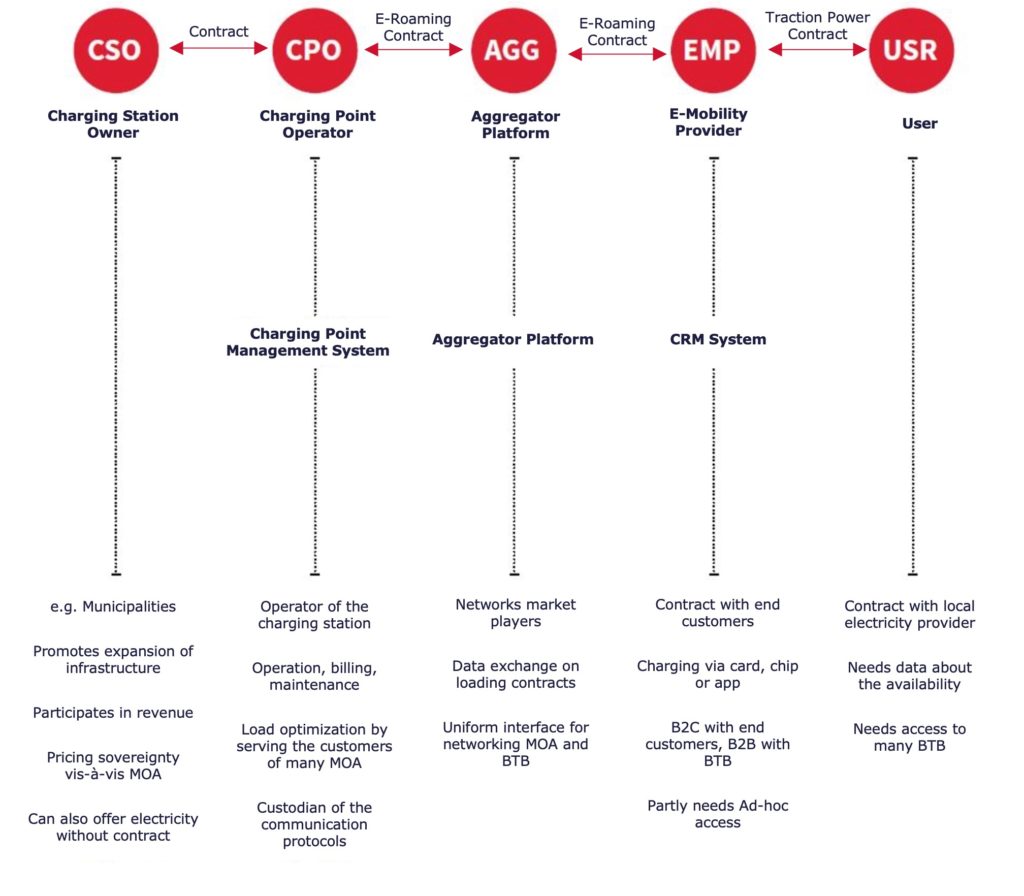
To the annoyance of customers, the payment modes at Germany’s electric charging stations differ depending on the operator. They often require membership and each issue their own cards. With around 1,700 charging points, RWE currently maintains the densest network. Customers pay a basic monthly fee of €4.95, which also allows them to fill up with electricity at partner companies. This option is known as e-roaming. The Group charges a further 30 cents per kilowatt hour charged.
Plugsurfing, a company founded in 2012, is tackling the proliferation of payment methods. It markets an app that is designed to enable payment at all charging points in Europe, regardless of the operator or platform. The service works similarly to PayPal. It is free of charge for the customer; the charges are borne by the owner of the charging point. In the Netherlands, payment with Plugsurfing is now possible everywhere. In Germany, at least 70% of the charging infrastructure is compatible with it. The complexity of the overall system results from the large number of market participants, their roles, and the differences in their positioning. This is illustrated in the following graphic:
Despite poor profit prospects, the oil company Shell is also planning to start building e-charging stations in 2019. For the time being, these are to supplement the fuel available at filling stations in the UK and the Netherlands. Because of the generally longer waiting time for electric refueling, the group hopes for more sales in the catering industry.
But it will hardly be possible to compensate for the declining business with fossil fuels by serving more coffee alone. Oil companies and service station operators will have to rethink their approach and open up new areas of business. This issue will become a matter of existential importance as soon as vehicles of autonomy level 5 approach market maturity. What will the gas station attendant sell the customer when the car rolls up to the fast charger without a driver? The entire automotive industry, including suppliers, will be faced with another major change when wireless charging systems become standard. At the latest, a mass-market concept for dynamic, inductive charging will put an end to the discussion about the capacity and range of traction batteries. Beyond its captivating convenience, such a system will enable massive savings on the e-car’s biggest cost item: the battery. This in turn will give electromobility a strong impetus for growth.
In Germany, the market environment for charging station services is as follows:
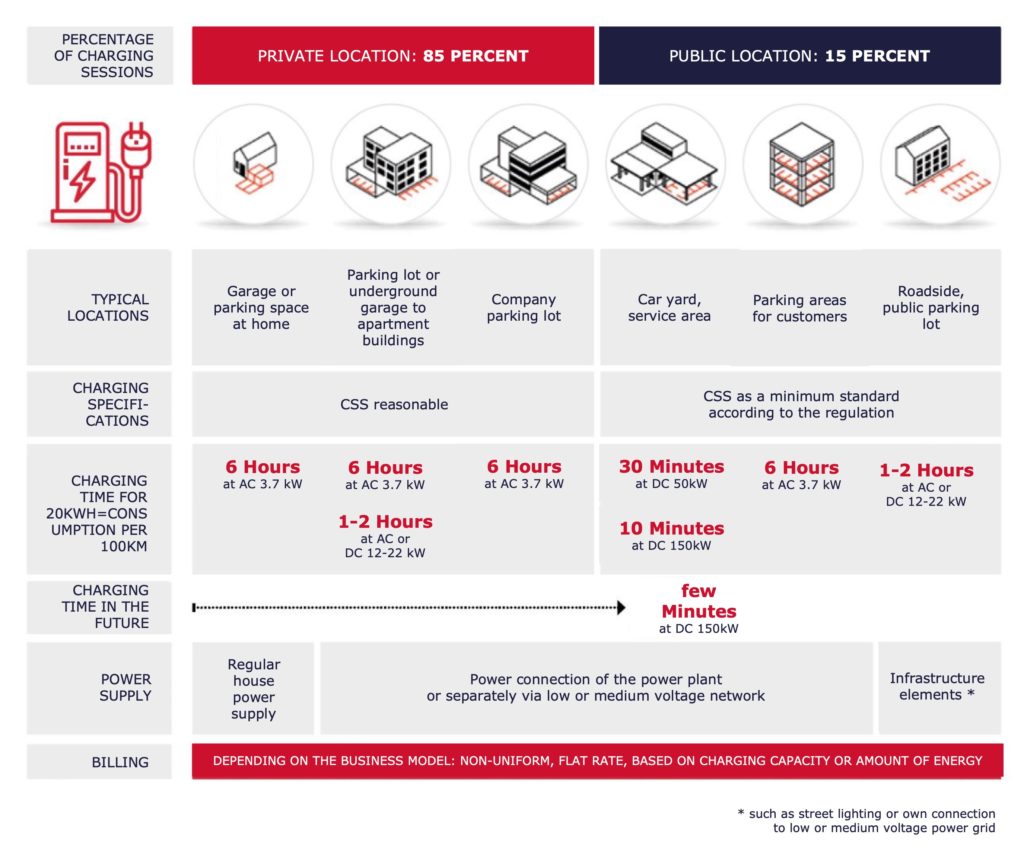
The Federal Network Agency has created a register with an active map of the infrastructure in Germany for the charging stations registered to date and certified by TÜV (blue= charging stations, red= fast chargers).
The German Federal Network Agency has created a register for the charging stations that have been registered and certified by TÜV to date, with more active infrastructure (blue= charging stations, red= fast chargers).
In 2018, electric vehicles accounted for just one percent of new registrations. In Germany, two-thirds of energy is still generated from coal and gas. That is why the carbon dioxide value of an e-car, measured in grams per kilometer, is still higher than that of a diesel car. To generate the electricity for the planned forty million e-vehicles in a climate-neutral way, an additional 35,000 wind turbines would be needed on land. Another, often neglected point is the 35 billion euros in state revenue from fuel taxes that would be lost through a system change.
The e-mobility calculator compares the costs of such a vehicle with those of a gasoline or diesel based on your mobility needs. Do the math yourself!
Predicting train delays is anything but easy. On a route network of a good 33,000 kilometers in length with over 5,000 stations, around 13.4 million travelers were on the move every day in 2019[1]. Delays result from the interaction of circumstances such as technical disruptions, construction sites, delays in boarding and alighting, or other delayed trains. Due to the multitude and complex interaction of such influences, rule-based forecasting systems quickly reach their limits.
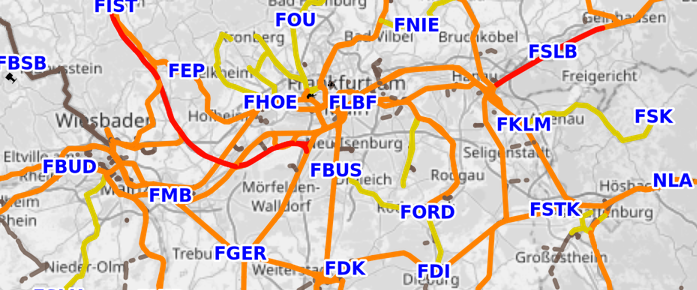
As is usual in Big Data projects, a large part of the work consists of preprocessing and transforming the input data. Diversely structured raw data from a multitude of sources must be merged into a consistent data model that is filtered as much as possible to eliminate implausible or inaccurate data records that may arise, for example, in the event of malfunctions. On the basis of the clean data, influencing variables – so-called features – are then calculated which are expected to explain the delay as well as possible. Such features are, for example, the current delay at the time the forecast is generated or the travel times planned in the timetable.
The route network is divided into individual sections so that there is a measuring point at the beginning and end of each section that records the passage of a train. For each of these route sections, a machine learning algorithm learns from past data to predict the increase or decrease in delay on that route section from the measured features. The predicted total delay is then the sum of the estimated increased or decreased delays on the route sections that still need to be traversed.
This basic procedure can be further refined. To do this, one must sometimes clarify fundamental questions first, such as: What exactly does it mean to minimize the error of the forecasts? The answer is by no means trivial. If one understands this to mean a minimum absolute error, i.e., the smallest possible average deviation of the forecast from the actual arrival or departure time, then one neglects the fact that an overestimated delay is more risky for the travelers than an underestimated one. If the system reports an early departure time, the passenger will wait longer than necessary at the platform, but if the train leaves before the predicted time, a traveler relying on the prediction may miss it. Thus, the measure of quality to which the forecast should be optimized is based on the assumption of how well passengers can live with the different types of errors.
Another area of optimization is the handling of special cases in the data. Particularly after disruptions, data flow into the forecast that result from a complex interaction between man and machine. A more differentiated consideration of such data constellations contributes to the continuous improvement of the forecasts.
Consileon also supports Deutsche Bahn in the operation and further development of a Big Data platform that processes data from sources such as timetables or train position reports within a streaming architecture in real time and provides it, among other things, to the applications for generating delay forecasts. The platform is also used to feed the forecasts into apps such as the DB Navigator app or the displays on the platform. It is based on a microservice architecture in which the individual components of the overall application can be quickly put into operation or exchanged. The cloud system was programmed with open source frameworks such as Kubernetes, Helm and Ranger. Grafana and Prometheus, among others, are used for monitoring. Throughout the project, employees of the client, Consileans and other external service providers work together in an agile manner according to the Scrum model.
[1] Deutsche Bahn – Daten & Fakten 2019
[2] https://www.openrailwaymap.org/
How to accelerate digitalisation and simplify management at the same time with ToC and Synergetics.
It is inevitable that digitalisation will continue to advance. However, if a company sees digitisation as an opportunity and wants to use it, it quickly reaches two limits. These limits are usually accepted as given and make life unnecessarily difficult.
The time will come again in September: Many specialists among you will hear Wolfram Müller give a wide variety of presentations on the topic of project management at the PMO Impact Summit . There he will share his expertise in the area of Theory of Constraints with you.

Especially with regard to the Corona Lockdown, much project work with your clients has been severely restricted. The BlueDolphin concept is perfect for responding to the new circumstances and achieving the best results despite all the restrictions.
„97% stand behind the Change.“
The Theory of Constraints (ToC) is a scientifically based thinking framework for looking at flow systems. Its application makes the bottleneck in the company visible and you get a signal that makes sense for all involved. This leads to the system of areas and departments optimising itself in a self-organised way in a very short time; completely without pressure from outside or additional costs.
The idea behind the BlueDolphin concept is to find the one main constraint, i.e. the bottleneck, as a first step. Starting there has the greatest leverage effect, while in other places it only leads to the problem getting worse. Examples of such constraints can be lack of resources, skills, rules or regulations.
„If you want to change – everyone has to see the need“
The idea behind the BlueDolphin concept is to find the one main constraint, i.e. the bottleneck, as a first step. Starting there has the greatest leverage effect, while in other places it only leads to the problem getting worse. Examples of such constraints can be lack of resources, skills, rules or regulations.
In the first step, Wolfram Müller’s team conducts an online analysis to identify the symptoms of unwanted effects. From this, the area in which the company is furthest away from the optimally achievable value can be derived. That is where the change begins. In the second step, the master plan is elaborated in workshops and top management is brought on board. Finally, everyone implements the measures developed together.
Since digital projects are often more difficult to implement than expected, we offer you a digital roadmap based on the Digital Readiness Check, which we support you in implementing on an ongoing basis.
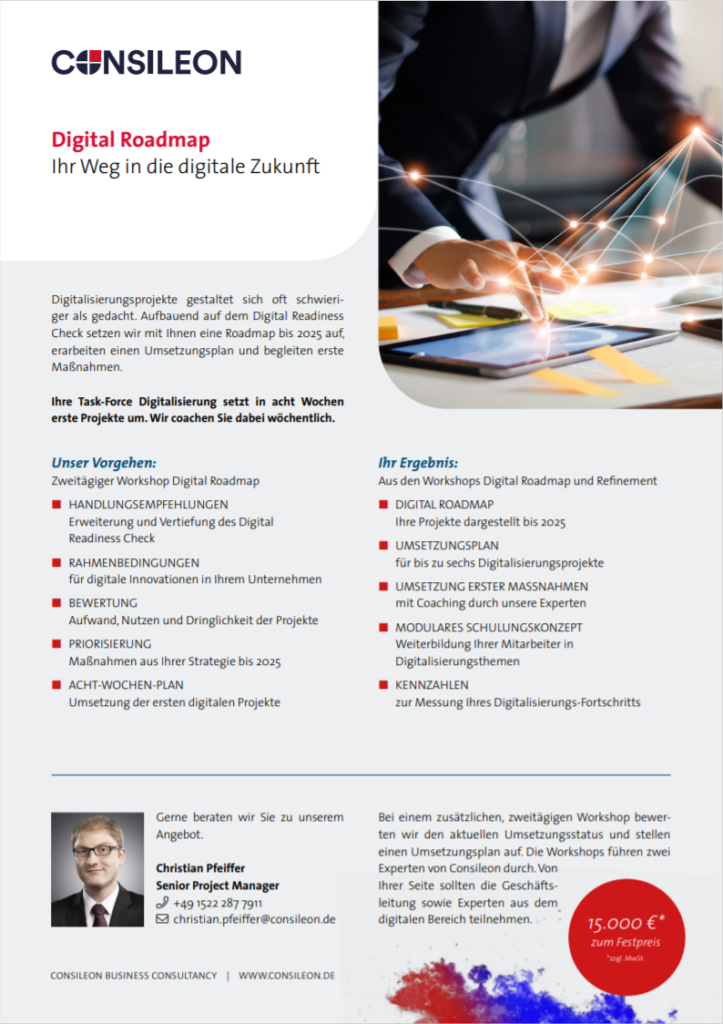
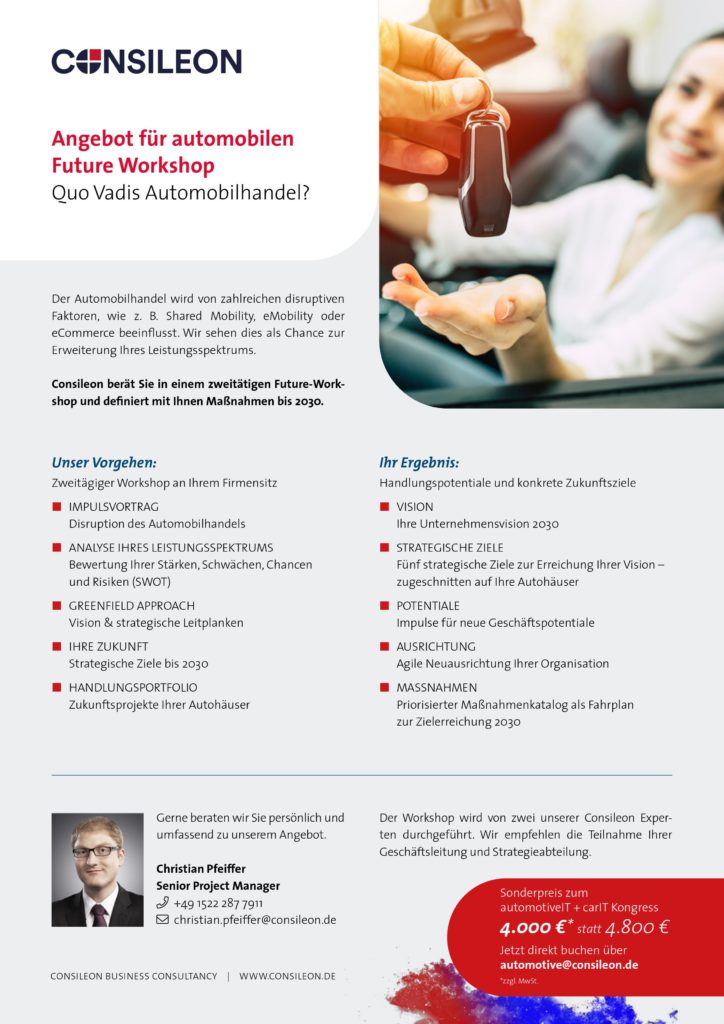
The Flyer is in German.
Die Zukunft des Automobilhandels hält viele Disruptionen bereit: Shared Mobility und eMobility, um nur zwei zu nennen. Diese Faktoren werden den Markt nachhaltig verändern und wir von Consileon sehen darin eine Chance für die Erschließung neuer Geschäftsfelder.
There is no question that digitalisation is an important component of the modern business world. But where exactly does my company stand on the digitalisation scale compared to other companies? We answer this question together with you in our Digital Readiness Check.
Two experts from Consileon will conduct a workshop with your management and other members of your IT department to answer all the important questions about customer expectations and trends in the digital world and then define the challenges your company is facing.
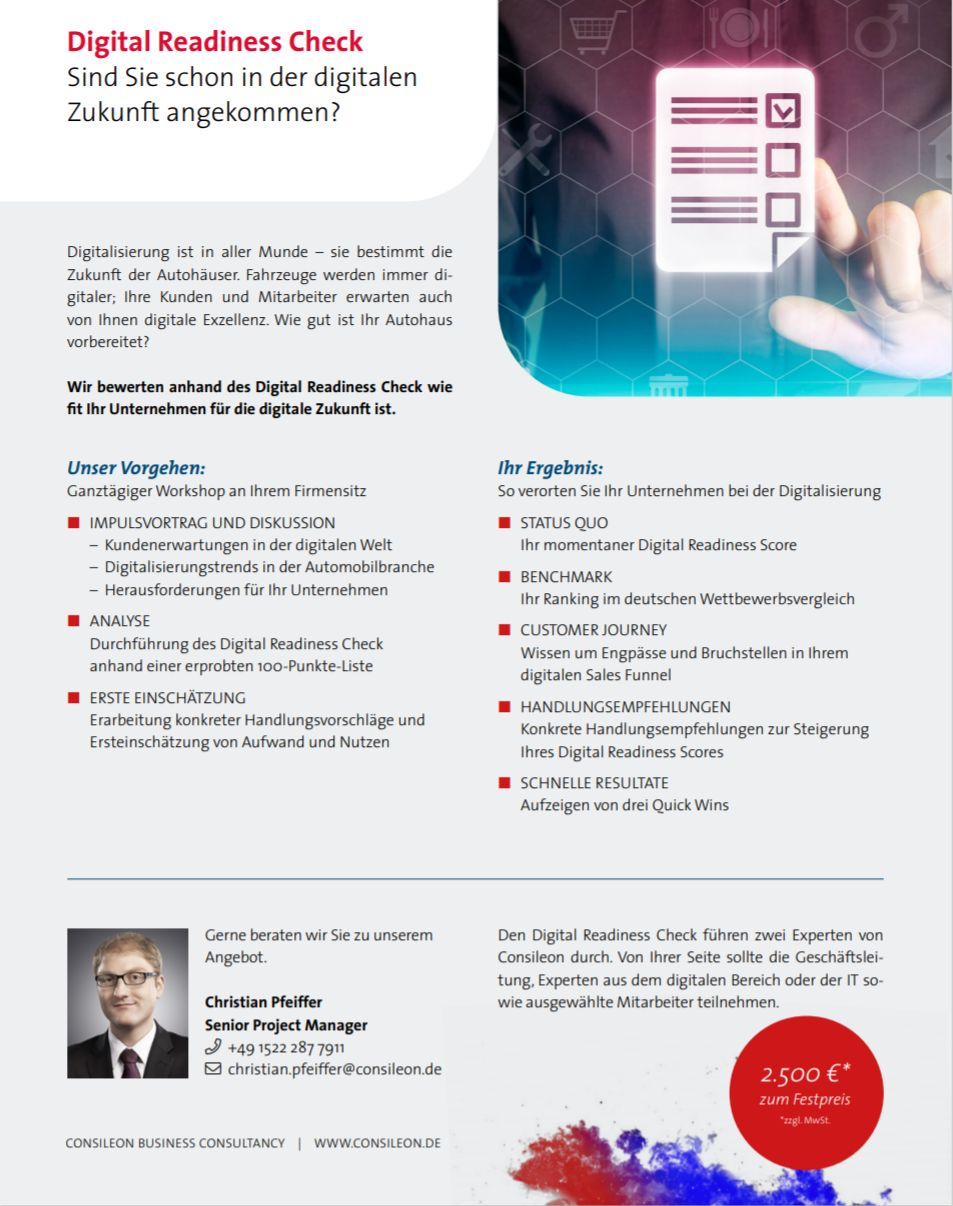
The Flyer is in German.
Private construction financing is a traditional and central pillar of the business model of German banks and Sparkassen. However, the persistently low level of interest rates combined with a flat yield curve has led to an erosion of interest margins in recent years and reduced the earnings of this former cash cow to an extent that in some cases threatens the very existence of the business.
The positive development of private construction activity among Germans, which is supported by the low level of interest rates and the robust situation on the labor market, can no longer compensate for these burdens on earnings, despite the associated increase in lending volumes.
A key challenge in the private mortgage business is the increasing affinity of broad sections of the population for digital information and transaction channels. Today’s – and even more tomorrow’s – bank customers expect their bank to provide a comprehensive and end-to-end range of services across all digital channels. Multi-channel excellence is becoming an important success factor for banks and savings banks.

Find out more in our article Private Construction Financing – Digitization as a Strategic Solution for “die Bank magazine.
(The article is in German.)
Times could hardly be more difficult for the global insurance industry. While premium income is stagnating, low interest rates are increasingly weighing on earnings. Added to this are competition from new rivals and cost pressure from regulation. However, all these problems are overshadowed by the biggest challenge facing the insurance industry: digitization.
What distinguishes digitization from the other challenges, however, is not only its secular dimension – but also the fact that, in addition to the often-invoked risks, it also brings enormous opportunities. This can already be studied using the example of other industries. In the automotive industry, it is already common practice for customers to obtain information online, configure their dream car and evaluate possible financing options. In the banking sector, which is the closest to the insurance industry, almost all players – regardless of size and across institution groups – are now also trying to use digitization for dialog between the bank and the customer. For example, not only major banks such as Deutsche Bank and HypoVereinsbank, but also regional institutions, savings banks, and cooperative banks are investing considerable sums in this area.
By comparison, the insurance industry is lagging behind in digitization. Insurers often associate the topic of digitization with sales and marketing issues. But the topic goes far beyond that, as it can influence claims processing or even the establishment of new business models. Even though some insurance companies have already recognized this – ERGO, for example, is giving the topic top priority as part of its new strategy program and is creating its own digital division with Digital Ventures AG – most insurers are still far from having a convincing omni-channel strategy. For example, the option of concluding a policy online is often missing, as are closed customer areas where insured persons can view their policies. The values of the cross-industry “Consileon Digital Readiness Index” match this diagnosis. This study analyzed the digitization strategies and concepts of individual companies with a view to creating a digital customer experience. The results currently show that nine automakers and three banks have “good” or even “very good” digital readiness. “good” or even “very good” results – but only for one insurance group (Allianz). Now, some insurance executives argue behind closed doors that their customers wouldn’t have it any other way. After all, 85 percent of all policies in Germany are still taken out offline. However, this interpretation fails to recognize that digitization is in the process of taking hold of the insurance industry with all its might. The best example is that more than half of all insurance customers already do their research online before signing up for a product, even though the contract is often signed offline (“Ropo effect”).
Learn more in our study One insurer – all channes. (The study is in German.)