
The United Nations’ Agenda 2030, the Paris Climate Agreement or the European Union’s Green Deal clearly express that global politics is setting the course towards a society and an economic model that are more strongly oriented towards environmental, social and good corporate governance criteria.
An important pillar of this transformation is the financial industry. Financial intermediaries play a key role in the transition to a sustainable economy. The money of private and institutional investors must be channelled into green projects. Products and processes must be established to meet the foreseeable surge in demand for sustainable investments. Last but not least, the own organisation has to be aligned sustainably in order to remain attractive for owners, investors, employees and customers.
The European Banking Authority (EBA) and the German Federal Financial Supervisory Authority (BaFin) not only ensure that banks and financial service providers address the sustainability of their business models. They are also driving the industry to deal with the risks resulting from the transformation at an early stage and to adapt their risk management accordingly.
But transformation does not only bring risks, but also opportunities: gaining trust, increasing customer satisfaction and strengthening one’s own business model.
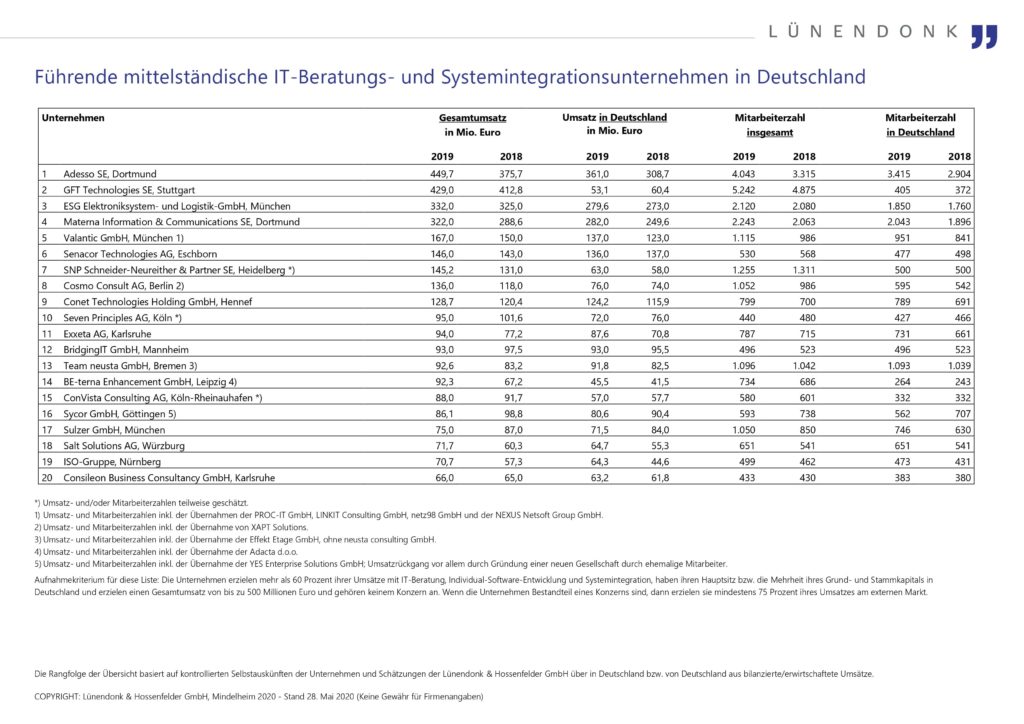
Consileon is once again among the top 20 medium-sized IT consulting and systems inter- nation companies in Germany.
The Lünendonk®-Liste 2020 „Führende mittelständische IT-Beratungs- und Systemintegrations-Unternehmen in Deutschland“ (engl. “Leading medium-sized IT consulting and systems integration companies in Germany”) is a ranking of the largest providers of IT consulting services that have their headquarters or the majority of their share capital in Germany and generate total sales of up to € 500 million. In addition to the achieved turnover, the number of employees is presented. The list has been available since June 23, 2020.
The 20 leading midmarket IT consulting and systems intervention companies achieved average revenue growth of 8.4% in 2019, generating total revenue of EUR 3.2 billion. Compared with the previous year (+13.8%), revenue growth was slightly lower. However, they developed more positively compared with the overall IT services market (+7.8%).
On 17.6.2020, Volkswagen’s new “ID.3 1st” successfully went live on our client’s German and several international websites. Other markets will follow successively, with our support.
An important feature is the emotionally designed model showroom with integrated online configurator, whose further development and continuous technical optimisation (new features, usability, etc.) has been significantly supported by several Consileon consultants for years.
The dealer search and various dealer contact modules that have been included since the new Volkswagen website went live (in September 2019) are constantly being further developed with our support and are currently being raised to the technical basis of MicroServices together with Volkswagen.
Consileon also supports the ongoing technical development of the Adobe AEM Content Management System on which the website is based.
On the business side, Consileans are mainly responsible for the global rollout of the integrated sales applications (including configurator, dealer search and contact modules) for Volkswagen passenger cars and commercial vehicles and are in constant exchange with the responsible international colleagues of the respective Volkswagen importers. Including CMS-only markets, the new website will be live in over 100 countries by mid-2020.
Consileon will continue to be responsible for the technical support of the live applications after the go-live.
We are pleased and proud to have been our client’s reliable partner in digital marketing for years and to be able to accompany Volkswagen in the digital transformation and on the way to e-mobility with currently more than 20 consultants with know-how and skill and in trusting cooperation!
Corporate customers and banks are at a crossroads. On the one hand, customers’ requirements are changing at an unprecedented speed. On the other hand, increasing regulation and the ongoing low-interest phase are leading to enormous cost pressure. But situations such as the Corona pandemic are also presenting banks and business customers with unprecedented challenges. All this has a significant impact on the future operating model of banks in the business with small and medium-sized customers, which shows strong similarities to the retail business. Take advantage of our many years of industry experience, including operational experience, to sustainably strengthen your segment for business customers.
Jürgen Chrobog, former German ambassador to the U.S. and member of Consileon’s advisory staff, comments on the current political situation in the U.S. and international cooperation under the Trump administration.

Click here to view the article by Jürgen Chrobog. (The article is in German.)
As never before, our society is being shaped by technological change. It is fundamentally changing the interaction between people, companies and machines.
Of course, the Internet, smartphones and digital disruption are not new phenomena. However, the current development is more dynamic than ever before. Innovations are emerging in increasingly shorter cycles and reaching people faster and faster. It feels like users have hardly any time to adapt to new developments and their possibilities.
Digital information and communication technologies are changing the way we deal with data. They are breaking down our classic role as data consumers because we can now change, create, share and network data ourselves at any time. The smartphone and its everyday applications serve as a dazzling example of this.
One consequence of this change is the emergence of completely new digital value chains. Small and medium-sized enterprises (SMEs) and banks are increasingly feeling the effects of this development. Formerly analog products, services and processes are being transformed into the digital world, opening up unimagined opportunities for action. SMEs can now achieve a similar market presence as was once only possible for larger companies. This fundamentally changes the structure of the SME segment. Physical barriers are being overcome in favor of digital networks.
The extensive opportunities presented by this development are only one thing – the other is the enormous challenges that this change brings with it. SMEs and banks serving this segment are at a crossroads. On the one hand, the requirements of their customers are changing at an unprecedented speed, while on the other, increasing regulation and the ongoing low-interest phase are leading to enormous cost pressure. All this has a significant impact on the future operating model of banks in their business with small and medium-sized customers.
The entry of disruptive market players (FinTechs) and the availability of new technologies are often portrayed as problematic for the business of traditional banks. We, on the other hand, see this development as an opportunity for traditional banks to reposition themselves on the basis of their traditional strengths (advice, risk management, market knowledge and customer trust) and actively shape the evolution of the SME segment.
Find out more in our study SME 2022 – Challenges in the digital transformation.
(The study is in German.)
The customer group of business customers is traditionally described as very heterogeneous in banks and segmented differently accordingly. Small companies with annual sales of up to €5 million represent the bulk of this segment at 97 percent, with 50 percent alone having annual sales of up to €100,000.
Today, the business customer segment is defined by its close ties to the retail customer business of the operating banks. While digitization has become increasingly important in the retail customer business over the past decade and is visibly shaping the dialog between the bank and the customer, business customers represent a highly neglected customer group in this development. In their daily work, customer advisors are often confronted with several hundred business customers without any digital support. At the same time, they are expected to provide holistic advice with a sales model focused on product sales.
There is hardly any digital support worth mentioning for the activities of the consultants. Instead, the establishment of call centers or business customer centers is used as a postulated modern support model. As a Consileon survey of business customer executives confirms, only 9 percent of respondents give high priority to the changing requirements of business customers when it comes to digitization.
While providers in the e-commerce and telecommunications sectors determine and evaluate their customers’ data and preferences almost in real time and use them to create an individual client experience, banks collect these values only very irregularly, or they use the collected data in a poorly targeted manner. Often, a personal dialog takes place only once a year using physical consultation forms.
But even this data rarely finds its way into banks’ systems for digital, strategic and sustainable use and customer engagement. Data collection is mostly focused solely on assessing credit risk and meeting regulatory-driven requirements. In the case of business customers, there are hardly any incentives to share information so as not to have an unnecessarily negative impact on access to important financing.
However, financial partnerships should also promote and allow structured dialog on “negative” developments. In addition, modern CRM systems can be used to address potential customers in a targeted and efficient manner. By intelligently linking internal information and information freely available on the market (e.g., via social networks), a targeted acquisition process can be created. Business customers are also increasingly learning to appreciate the advantages of digital platforms, products and services and are increasingly using the services of non-banks or FinTechs for this purpose, e.g. for payment transactions, financing or currency transactions. The increasing acceptance of these services in particular should worry banks, as the digital providers now know more about their customers in some cases than the bank advisor himself and are increasingly using this knowledge strategically for an individualized private and business approach to business customers.
Learn more in our article for the magazine “die bank”. (*only available in German)
Small and medium-sized enterprises (SMEs) are increasingly expecting the use of modern media and innovations from other industries in financial management as well. FinTechs have already discovered the attractiveness of the SME segment and are increasingly threatening the market share of established banks. The latter must assert themselves in the face of new competitors and changing customer requirements in order not to lose their still existing trust advantage. With a “business as usual” approach, they will lose their connection and their relevance. A digital overall proposition tailored to SME requirements and incorporating an SME platform can contribute to sustainable success.
The focus is on the digital integration of products and services into SMEs’ business processes and the provision of functionalities. Automation of similar processes and transparency in communication sharpen the profile of the digital offering for SMEs. Content and services do not only have to be provided by the bank. Strategic integration of third-party providers into the SME platform further completes the overall proposition and offers SMEs a comprehensive range of services from a single source.
The expectations of SMEs are clear: instead of one-dimensional product-related consulting, they expect qualitative interaction with banks and partners. By consistently aligning the platform with the requirements of SMEs, banks can maintain the trust they still have and build on it by increasing their presence in the SMEs’ day-to-day business.
Does the data exchange between your IT systems work from patient admission to treatment and discharge? Are you able to bill all services to payers without any complaints? Are your staff constantly waiting for data to be updated on the screen? Or do you have a powerful network connection and software modules that guarantee short access times?
A hospital’s IT consists of systems from multiple manufacturers. Modules from the same system or manufacturer are sometimes commissioned several years apart. This sometimes causes communication problems between new and older versions. Systems grow without a master plan, and hospital operations adapt to them rather than reflect them. In many cases, staff must manually rework.
A powerful IT landscape that does not slow down processes or require manual rework is important for smooth hospital operations. The foundation for advancing digitization is and remains a highly efficient IT landscape.
According to Report Mainz, a German politician was blackmailed in 2019 for his hacked health data. Similarly, patient data is a popular commodity on the darknet and trades higher than credit card information, according to Arzt Wirtschaft. When doctors’ offices were connected to the telematics infrastructure in 2019, malware was already found on many systems to grab data. In 2018, three million patients in Norway found that their data had been hacked. Could Germany also be threatened by something like this? The likelihood is not so small, especially because cyberattacks increased significantly during the Corona crisis. It’s better not to be one of the victims – but to take control of your IT security from the very beginning.
And that’s right from the start! Security strategy will save you uncontrollable costs and sleepless nights. When developing your IT strategy, we plan your “safety net” right from the start, precisely because IT is becoming increasingly complex in the healthcare sector. Existing IT systems are being connected to more and more new solutions, potentially opening the door for a new attack. The security strategy therefore includes an analysis of the entire system landscape, including interfaces to their partners or new software. Especially the necessary, rapid digitization measures in the context of the Corona epidemic often still have vulnerabilities that must be quickly eliminated.
However, a custom-fit IT security strategy is not a one-time step. IT security is a process that begins with software selection and continues throughout its lifetime. The final IT risk can only be eliminated if your employees consistently apply the security strategy once it has been established. Unfortunately, it has been shown time and time again that the person sitting in front of the computer is the biggest security risk. Many successful attacks are due to the – usually unconscious – misconduct of individuals. The only thing that can help here is to train and sensitise your employees to the dangers of digital communication and networking. We offer both: learning and action.